Sustainability Goals 2030

Sustainable development aspects strongly shape Kärcher’s activities and are increasingly embedded in our supply chains. Our measures aim at reducing our footprint, driving circularity, and increasing transparency by making our progress measurable and manageable. Our sustainability goals reflect how Kärcher wants to contribute to a more sustainable future by taking responsibility for both our planet and its people. Kärcher is committed to continuously creating a fair, safe and prosperous working environment and to contribute to the overall picture of a more sustainable future.
Sustainability Goals 2025 - be the difference

Targets for 2030 at a glance

A responsible use of natural resources, the reduction of our footprint, and social responsibility form the basis of our actions. In accordance with our sustainability goals, we have implemented meaningful measures to systematically make our company more efficient and resource-conserving and to fulfil our role as a social stakeholder.

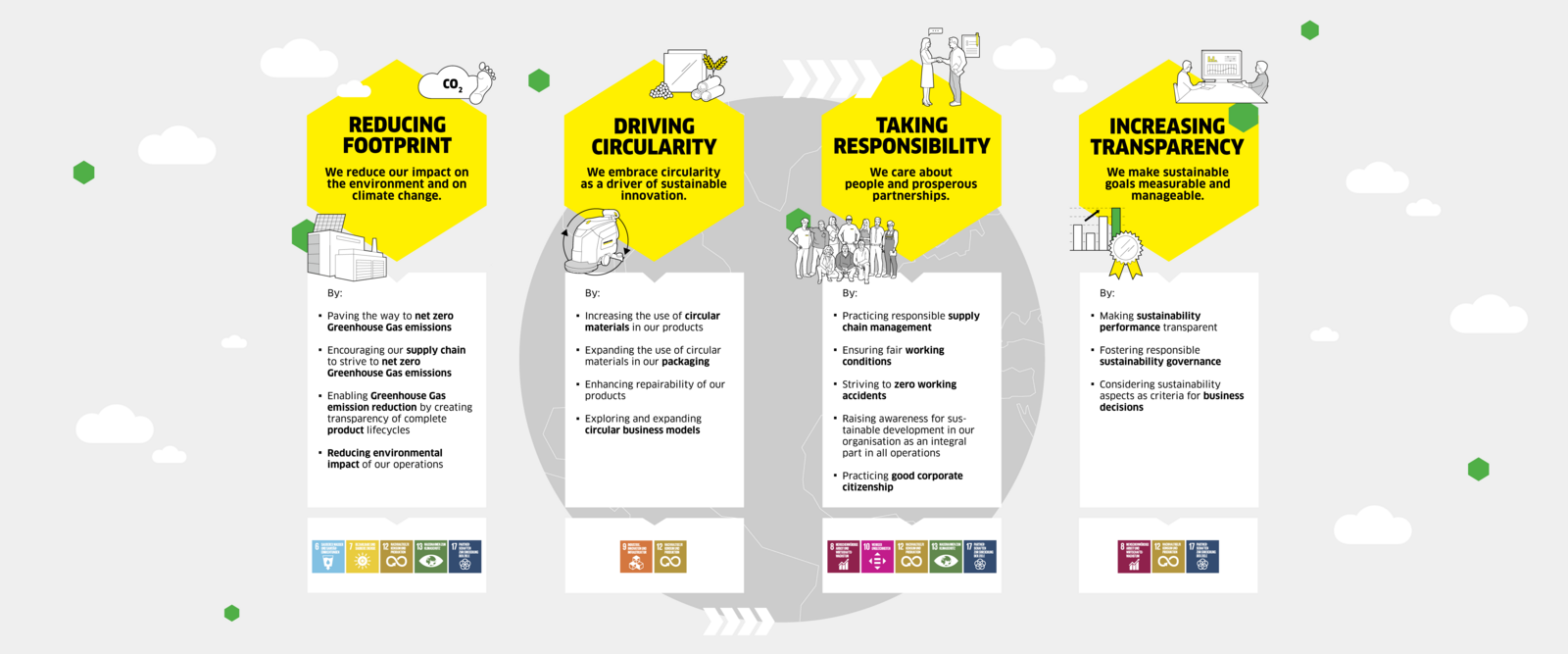
Our 2030 sustainability goals take into account current societal and regulatory developments, market dynamics, and future trends. By working towards these targets, we also support efforts of reaching several of the Sustainable Development Goals of the United Nations (UN). Kärcher has set out specific and measurable sustainability targets in four initiatives: By “Reducing Footprint,” “Driving Circularity,” “Taking Responsibility,” and “Increasing Transparency,” Kärcher takes responsibility and acts to address globally relevant challenges.

Reducing Footprint

Kärcher will take measures to significantly reduce its impact on the environment and climate change by encouraging our supply chain to strive to net zero Greenhouse Gas emissions, by fostering transparency across complete product lifecycles, and by reducing the overall environmental impact of its operations.

Kärcher is developing a comprehensive Climate Transition Plan that defines measurable targets and concrete actions for decarbonisation. As specific goals, Kärcher seeks to reduce its scope 1 & 2 emissions worldwide by 42%, and scope 3 emissions caused by purchased goods and use of sold products by 51.6% per TEUR added value until 2030.* To achieve these reduction targets, Kärcher has identified measures alongside the value chain, e.g. including the use of electricity from renewable sources** across the entire Kärcher Group.

* Scope 1 & 2 compared to base year 2020, Scope 3 compared to base year 2022.
** From solar power (on- and off-site), hydropower, wind power.

By 2030, Kärcher will also increase the transparency of its products’ climate impact by calculating a traceable carbon footprint for 60% of product turnover.* Increased transparency through Product Carbon Footprint hotspot analysis in new product developments will help define concrete measures. Building on this, CO₂e is included as a development criterion** in new product developments, and relevant and appropriate CO₂e reduction targets are set. 

* new products, existing products with turnover > 1M €/a, excl. Americas, trade goods, accessories, affiliated companies
** start 2028, excl. Americas, trade and existing products, accessories, affiliated companies

In addition, Kärcher is working closely with suppliers to lower CO₂ emissions from purchased goods by 15% per TEUR of gross sales by 2030 (from a 2022 baseline). These measures include comprehensive data transparency for the carbon footprint across the supply chain's main contributors, training suppliers regarding Kärcher’s emission reduction targets and expectations, as well as establishing global contract standards for new suppliers.

By 2030, Kärcher aims to increase its water efficiency by 5%*, improve its recycling rate of total waste to more than 90% worldwide2, and achieve a 12% improvement in energy efficiency** in its operations***. These goals will be reached through optimised production processes, the roll-out of a zero-production-waste and a water efficiency initiative across all plants, and increased employee awareness of corresponding sustainability aspects and how they can be affected by their behaviour.

* compared to 2024
** compared to 2022
*** Own operations include the Kärcher headquarters and the production and logistics sites of the Kärcher Group

Reducing Footprint

Driving Circularity

At Kärcher, we embrace circularity as a driver of sustainable innovation. Therefore, we will increase the use of circular materials in our products and packaging, enhance the repairability of our products, and explore new circular business models.

By 2030, Kärcher will improve the weighted average between circular inflow and circular outflow of materials* by 5%**. As part of this, we will increase the percentage of circular plastics*** in our products to 15% and are committed to increasing the circular, regrowing, plant-based inflow****. To achieve these goals, Kärcher will increase transparency in inbound and outbound material flows, define focus materials based on circularity and recyclability, and implement targets within product development projects. 

* Including plastics, steel, and regrowing plant-based materials.
** Base year 2025.
*** Recycled plastics.
**** Related to detergents, depending on feasibility.

By 2030, our goal is to ensure that 100% of our packaging portfolio*** goes beyond the PPWR* 'Design for Recycling' requirements with a minimum technical recycling ability of 90%**. Furthermore, we aim to achieve an average of 80% recycled content across our primary and secondary packaging***. To reach this goal, we will enhance transparency and measurability across the value chain by integrating CO₂e data, circularity indicators, and sustainability criteria for materials and packaging into standard databases and core processes such as product development and procurement.

* PPWR (Packaging and Packaging Waste Regulation - Regulation (EU) 2025/40)
** >Grade B (PPWR)
*** excl. Americas / American Plants, affiliated companies; based on total mass calculation

An effective measure to reduce material use is extending the lifespan of products through better repairability and to improve recyclability. Therefore, we seek to enable design concepts and strategies that support easy disassembly, innovative product design, and attractive repair options through an improved spare parts strategy.

Kärcher will increase our products’ repairability beyond compliance by integrating a voluntary repairability calculation method into 50% of our product categories*. All new product developments with a legally required Repair Index will achieve a score of 8.5/10 or higher**.

* excluding product groups or categories with legally required Repair Index, driven devices, configured devices and plant engineering, similar product categories are summarized, product categories are defined as sub category of Kärcher product groups with same product concept (e.g. trimmer, pumps, blowers in Garden product group)
** excluding spare parts pricing

By 2030, Kärcher will also increase the number of circular business models, such as rental and refurbishment options, offered in our sales organisations by 90% compared to 2025. To explore and advance innovative and relevant circular business models, Kärcher is creating a dedicated expert team tasked with enabling organisation-wide circular business processes. 

Driving Circularity

Taking Responsibility

We care about people and prosperous partnerships. For Kärcher, this means promoting responsible, fair, and safe conditions along its entire supply chain. 

Kärcher is committed to establishing a responsible supply chain by 2030 through proactive ESG risk management, enhanced transparency, and continuous supplier development with a focus on responsible, deforestation- and conflict-free sourcing.  Kärcher will only work with suppliers who demonstrate ethical labour practices and uphold the protection of human rights. In addition, Kärcher aims to empower suppliers to improve their sustainability performance through collaboration and capacity building.

Kärcher strives to create and maintain a fair working environment by following relevant ILO (International Labour Organisation) standards and guaranteeing that all employees* are paid a local living wage. To support this, Kärcher will establish a global framework for wage calculations that accounts for regional cost-of-living differences and complies with ILO standards.

* Own workforce, excl. leasing employees

It is our profound ambition to achieve a state of zero working accidents* across all operations, ensuring that all employees return home safely every day. To achieve this, Kärcher will develop a global occupational health and safety management system, will monitor accident frequency and severity, and champion occupational safety through communication, education measures, and campaigns.

* All accidents resulting in ≥1 day lost.

As part of our Sustainability Strategy 2030, we want to empower the people in our organisation to become more aware of corresponding environmental, social and economic aspects. Kärcher seeks to raise awareness through specific measures, including training, awards, and events, and to ensure that the sense of urgency is understood and accepted by Kärcher employees, and that the goals of our Sustainability Strategy 2030 are taken into account in daily business and standard operations.

Kärcher is committed to the continuation and quality improvement of its global Corporate Citizenship activities to achieve meaningful societal impact and strengthen their connection to the company’s expertise and core business. Efforts will increasingly focus on cleaning and hygiene as well as disaster relief. Furthermore, we will improve impact measurement and internal reporting, and raise the visibility of our subsidiaries’ corporate citizenship initiatives worldwide.

Taking Responsibility

Increasing Transparency

Kärcher makes sustainability goals measurable and manageable by systematically collecting and analyzing ESG data, benchmarking against peers and engaging stakeholders across functions.  Kärcher aims to improve its ESG performance and therefore is working on positioning itself among the top rated companies in leading ESG ratings such as Ecovadis, CDP and NQC Supplier Assurance. 

We* foster responsible sustainability governance by actively contributing our expertise to shape the future regulatory landscape through targeted engagement in key working groups and committees** focused  on European and global sustainability compliance***, complemented by involvement in relevant voluntary sustainability initiatives****.

In addition, Kärcher continues to harmonize and expand its sustainability compliance and governance management system.

* Corporate Sustainability Management
** e.g. associations, standardization organizations, industry expert groups
*** VDMA, ZVEI, EPTA, EUnited, Fraunhofer, IEC
**** globalverantwortlichBW, Klimabündnis Baden-Württemberg, UN Global Compact, UPJ

Sustainability aspects will be systematically integrated into business decisions at all levels. By defining clear criteria for decision-making processes and embedding sustainability indicators at Management Board and Supervisory Board level, Kärcher ensures that sustainability acts as a driver for both corporate awareness and long-term strategic culture.

Increasing Transparency