Disposal and Take-back Information
Information on the Disposal of Batteries pursuant to Article 74 of the Battery Regulation (2023/1542/EU)
In our capacity as a manufacturer and distributor of battery-powered products, we promote the sustainable management of energy storage devices. The following information will help you use batteries responsibly and ensure they are properly recycled.
Our Battery Systems
Kärcher uses the following battery categories:
- Portable batteries: Used in cordless cleaning devices and professional cordless platforms
- Industrial batteries & starter batteries: Lead-acid or lithium-ion based batteries used in large cleaning machines
- Electric vehicle batteries: Used in sweepers
Environmental Impact
Used energy storage devices contain valuable components such as nickel, zinc, manganese, or iron that can be recovered through recycling. At the same time, they often contain heavy metals or pollutants that can harm human health and the environment if handled improperly. For this reason, used batteries belong in designated collection points.
Your Contribution to Waste Prevention and Recycling
Make an active contribution to waste prevention by preferentially using rechargeable batteries.
Optimal Storage: Batteries should be stored in dry, cool, and well-ventilated areas. Avoid direct sunlight or storage near heat sources.
Charging Management: Only use the original chargers recommended by us. Using incompatible systems can endanger safety and shorten lifespan.
Avoiding Deep Discharge: Never store batteries in a discharged state, as this can lead to permanent chemical damage. If the battery will not be used for a long period (more than one month), it is recommended to remove it and recharge it regularly (approx. every 2-3 months).
Legally, as the end user, you are obliged to ensure that batteries are properly returned for recycling. Free collection points are available in stationary retail, at municipal waste management companies, or directly at our locations. Please observe locally applicable regulations.
Make sure to remove non-destructively removable batteries from your electrical appliances and dispose of them separately from the old appliance. In the case of permanently installed batteries (integrated rechargeable batteries), removal should only be carried out by qualified specialist personnel or Kärcher Service to avoid short circuits or damage.
Safe handling of used batteries
Never open or disassemble batteries yourself. Keep them away from heat sources, water, and children.
Lithium systems, in particular, represent a potential source of danger due to their considerable energy density. If lithium batteries are damaged, swollen, or overheated, there is a risk of fire! Therefore, it is important to remove the batteries and dispose of them separately before disposing of the Waste Electrical and Electronic Equipment (WEEE). By taping the terminals with insulating tape before disposal or handover of the used batteries, the risk of fire with lithium batteries can be additionally reduced.
Furthermore, please observe the information in the operating instructions for our devices and batteries.
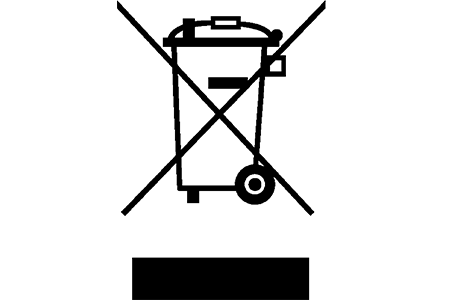
Relevant Labeling:
The crossed-out wheeled bin means: Batteries and rechargeable batteries must not be disposed of in household waste and must be disposed of separately!
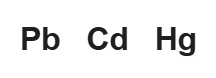
If symbols such as Pb (lead), Cd (cadmium), or Hg (mercury) are located under the wheeled bin, this means that the battery contains these dangerous substances above the legal limit values.
Information on financial contributions for batteries
Information on the disposal costs included in the price according to Article 56 (4) of the Battery Regulation (EU) 2023/1542 can be found on our local websites.
Information on the Disposal of Waste Electrical and Electronic Equipment pursuant to the WEEE Directive (2012/19/EU)
Environmentally friendly products, services and processes are embedded in our corporate mission statement. We therefore also fulfil the obligations of the European WEEE Directive and would like to point out the following.
Old electronic devices must not be disposed of with household rubbish. Consumers are legally obligated to take these to an appropriate collection point (of a business or local authority). You can also return your old devices free of charge to any Kärcher Center.
Please note that electrical and electronic devices for commercial purposes (B2B) must be disposed of via municipal collection points. We will be happy to inform you of suitable disposal options.
Please remove non-rechargeable and rechargeable batteries insofar as possible and dispose of these in an environmentally friendly manner using appropriate collection systems. For devices with data storage, you are obliged to delete personal data.
The crossed-out wheeled bin sign means that old electronic devices must not be disposed of with household rubbish.
Old devices may contain harmful substances that could damage the environment and health. Old devices are recycled, as they contain important raw materials.
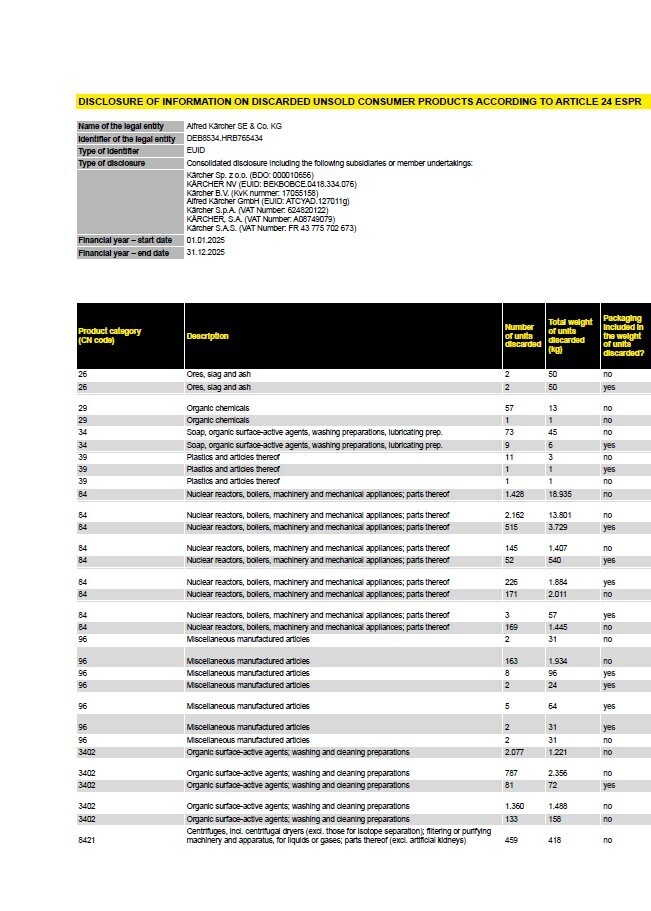
Disclosure of information on discarded unsold consumer products
In accordance with Regulation (EU) 2024/1781, we are fulfilling our obligation to disclose data on disposed, unsold consumer products. You can find all the necessary details in the document below.